Where it began
In the years after the Second World War, a handful of Kansas City families made a habit of driving south on Friday nights to float the clear, spring-fed streams of the Missouri Ozarks. Aluminum canoes were new and affordable, the rivers were still largely unknown outside the hills, and there was no guidebook. In 1956 those families organized themselves into the Ozark Wilderness Waterways Club, with two purposes that have never changed: to get out on the water together, and to help keep those streams wild.
The second purpose was not an afterthought. Within a few years the club was running an organized clean-up of an Ozark stream every summer, a tradition that began in 1960 and continues today. In 1970 an Associated Press photographer caught a club work party on the Current River with a day’s haul of garbage, and described the members as “city folk who revere the wilderness and are prepared to act to keep it unspoiled.”
Oscar “Oz” Hawksley
Founder
A biology professor who taught for three decades at what is now the University of Central Missouri in Warrensburg, Oz Hawksley started the club in 1956 and gave it its character: part expedition, part field trip, part river advocacy. He was a founding member of American Whitewater, wrote for its journal through the 1950s and 60s against new dams and for wild river protection, and in 1965 published Missouri Ozark Waterways, the Missouri Conservation Commission guidebook that introduced generations of floaters to the state’s streams. He was an early voice for what became the Wild and Scenic Rivers Act of 1968.
Rivers worth saving
The streams the club floated in its first decades became the proving ground for American river protection. The Current and Jacks Fork were set aside as the Ozark National Scenic Riverways in 1964, the first national park unit created to protect a river system. The Eleven Point was among the original eight rivers named in the Wild and Scenic Rivers Act. Club members worked alongside the Ozark Society and others in the long fight that made Arkansas’s Buffalo the country’s first National River in 1972.
Becoming Stream Team #41
When Missouri launched its volunteer Stream Team program, OWWC was one of the first groups to sign up, becoming Stream Team #41 on June 13, 1989, and adopting the Blue River in Kansas City. By 2007 the state tallied nearly nineteen tons of trash the club had pulled from eight Missouri rivers, more than three hundred hours of water-quality monitoring, and over 7,700 volunteer hours in all.
“It’s hard work, but we are blessed with such beautiful streams in Missouri; it is easy to give back by taking care of a few of them.”
Judith Guyn, OWWC member, in Missouri Conservationist, June 2007
Today
The club is still built on the same pattern: a monthly meeting, member-led trips, a newsletter, and a yearly clean-up. The boats are lighter and the trip list is longer, with kayaks, backpacking, and bicycling alongside the canoes, but the second Saturday still fills a room in Kansas City with people who would rather be on a gravel bar.
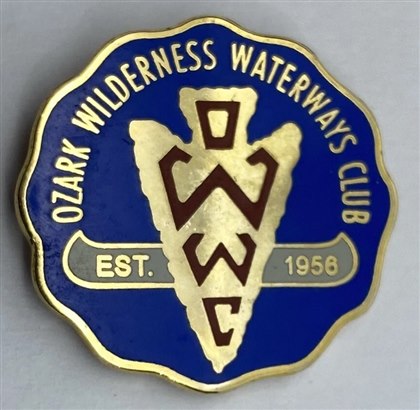
The club pin tells the story in one picture: an arrowhead, for the long human history of the Ozark hills, laid over a canoe, with the letters O W W C and the founding year, 1956.